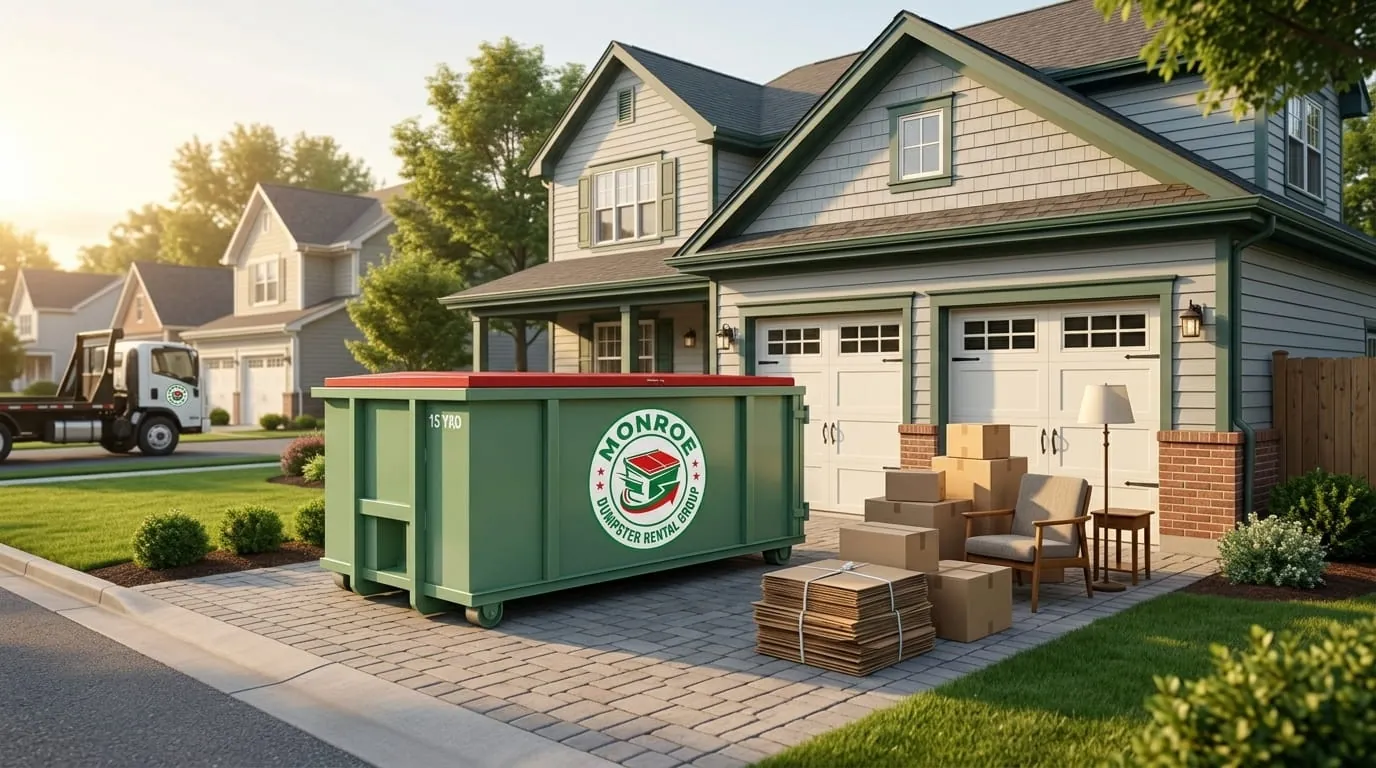
Your driveway is one of the most expensive surfaces on your property, and it is almost always the most convenient place to set a roll-off dumpster during a home project. Whether you are gutting a kitchen in an older Monroe brick ranch, clearing out a garage in one of Union County's newer HOA neighborhoods, or tackling a full roof tear-off, that container is going to sit on your concrete or asphalt for days. A loaded 20-yard box can weigh several tons, and if it is dropped, dragged, or parked without protection, it can crack, gouge, or stain a surface that costs thousands to replace. The good news is that with a little planning, and by working with a company that treats your property with care, you can rent a dumpster and hand back a driveway that looks exactly like it did before.
Why Heavy Roll-Off Dumpsters Threaten Driveways
A roll-off dumpster is not a static object that simply rests on your driveway. It arrives on a truck, gets winched off the back, rolls on steel wheels, and takes the full weight of whatever you throw into it. Every stage of that process puts stress on your surface. The three biggest risks are point loading, surface abrasion, and staining.
Point loading happens because the weight of the container is not spread evenly. The rear wheels and the front tongue (the leg that supports the empty end) concentrate thousands of pounds onto a few small contact points. Concrete can crack under that pressure, especially at expansion joints or along edges. Asphalt, which is softer and more flexible, can dimple or depress where the tongue and wheels sit. Abrasion happens during delivery and pickup when the steel frame slides across the surface. And staining comes from the metal frame itself, which can leave rust marks, plus any hydraulic fluid, paint, or debris that leaches out of the container over time.
Homeowners across the Charlotte metro deal with a mix of surfaces. Many established Monroe streets feature poured concrete driveways on brick ranches from the 1960s and 70s, while newer subdivisions off Highway 74 and out toward Waxhaw and Indian Trail tend to have broom-finished concrete or asphalt aprons. Each reacts differently to load, and each deserves protection.
The Piedmont NC Factor: Heat, Humidity, and Red Clay
Union County's climate makes driveway protection more important here than in cooler parts of the country. Our hot, humid Piedmont summers routinely push surface temperatures on dark asphalt well past 130 degrees on a sunny July afternoon. Hot asphalt softens, and soft asphalt deforms. A dumpster tongue that would barely mark the surface in November can sink a visible depression into a driveway during an August heat wave. If you are renting in the warm months, this is the single biggest risk to watch.
Red clay is the other local wildcard. Piedmont soil is heavy in clay, which drains slowly and turns soft and greasy after our frequent summer thunderstorms. A yard that feels rock-hard in a dry spell can become a rutted mess under a loaded container after one good downpour. That matters when you are deciding whether to place a dumpster on the driveway, the street, or the grass. Here are the local conditions worth planning around:
- Afternoon heat: Schedule deliveries for morning when asphalt is coolest and firmest, and use board protection under load points.
- Sudden storms: Never place a heavy container on a red-clay yard if rain is in the forecast; you risk deep ruts and a stuck truck.
- Humidity and rust: Prolonged moisture speeds up rust transfer from the steel frame to light-colored concrete.
- HOA rules: Many newer Union County neighborhoods restrict street placement and set time limits, which often pushes the container onto your driveway.
Plywood and Boards: Your First Line of Defense
The simplest, most effective way to protect a driveway is to put a barrier between the dumpster and your surface. Professional haulers and careful homeowners use planks or sheets of plywood as a buffer that spreads the load and prevents direct metal-to-surface contact. The principle is straightforward: the more surface area the weight is spread across, the lower the pressure at any single point.
You want protection in two specific places. First, under the rear wheels, where the container rolls and bears weight. Second, under the front tongue, which is the most common culprit for punching a dent into asphalt. A few practical tips:
- Use thick material. Two-by-lumber or three-quarter-inch plywood works far better than a thin scrap panel that will simply crack under load.
- Cover both contact zones. Place boards under the wheels and a separate pad under the tongue leg.
- Lay boards flat and stable so the driver can position the container squarely on top of them.
- For a long rental on asphalt in summer, double up the tongue pad to further distribute weight.
A reputable company will bring and place this protection as part of the delivery. When you book residential dumpster rental with a local outfit that knows Piedmont driveways, surface protection should be part of the conversation, not an afterthought.
Choosing the Right Placement: Driveway, Street, or Yard
Where you put the container is as important as what you put under it. Each option has trade-offs, and the right answer depends on your specific lot, your surface, and your neighborhood rules.
Driveway placement
This is the most popular choice for Monroe homeowners because it keeps debris close to the work and off public property. It is usually the best option as long as you protect the surface with boards and avoid the hottest part of the day. Concrete driveways in good condition handle a properly protected container well.
Street placement
Placing the dumpster at the curb spares your driveway entirely, but it comes with rules. Some Union County municipalities and many HOAs require a permit or prohibit street placement outright, and time limits are common. Check before you assume the street is available.
Yard placement
Setting a container on grass avoids surface damage but introduces the red-clay problem. On a dry, firm lawn with plywood underneath, it can work for a short project. On soft or sloped ground, or before a storm, it invites ruts and a container that settles unevenly. When in doubt, choosing the right 20-yard dumpster size and a firm placement spot beats forcing a large box onto marginal ground.
Preventing Gouges During Loading and Unloading
Most driveway damage does not happen while the dumpster sits still. It happens in the few minutes during delivery and pickup, when the container is being winched, rolled, and set down. This is where an experienced driver earns their keep. A skilled operator will approach straight, lower the container gently, and avoid dragging the rear frame across your concrete.
As a homeowner, you can help the process go smoothly. Clear the delivery path of vehicles, basketball hoops, low branches, and trash cans so the driver has a clean, straight approach. Point out any weak spots, sprinkler heads, septic components, or shallow utility lines before the truck arrives. Make sure the placement spot is level; a container set on a slope wants to shift as it fills. And decide in advance exactly where you want it so the driver is not repositioning a multi-ton box back and forth across your surface. A quick conversation at delivery prevents almost every avoidable gouge.
How a Good Dumpster Company Protects Your Property
Ultimately, the biggest factor in whether your driveway survives is the company you hire. A careful local hauler builds surface protection into their process. They ask about your driveway material and condition, they carry and place boards under load points, and they train drivers to set and retrieve containers without dragging. They know the difference between a shaded November delivery and a blistering July one, and they plan placement around Piedmont heat and clay.
At Monroe Dumpster Rental Group, we work on driveways across Monroe and Union County every week, from decades-old brick-ranch concrete to fresh HOA aprons. Because we are a local, flat-rate, call-only operation, you talk to someone who knows your neighborhood and can advise on placement before the truck ever rolls out. That local knowledge is exactly what keeps your surface intact. If you have questions about protecting a specific driveway, our team is happy to walk through it with you before you book.
Ready to rent with your driveway in good hands? Call Monroe Dumpster Rental Group at (980) 446-2528 for straightforward, flat-rate service, or reach out through our contact page to plan the safest placement for your Union County project.
Founder, Monroe Dumpster Rental Group — sharing straight advice from more than 15 years of local hauling experience.